Data Security Measures Guiding Electronic Payment Flows for Ongoing Customer Agreements in American Online Platforms
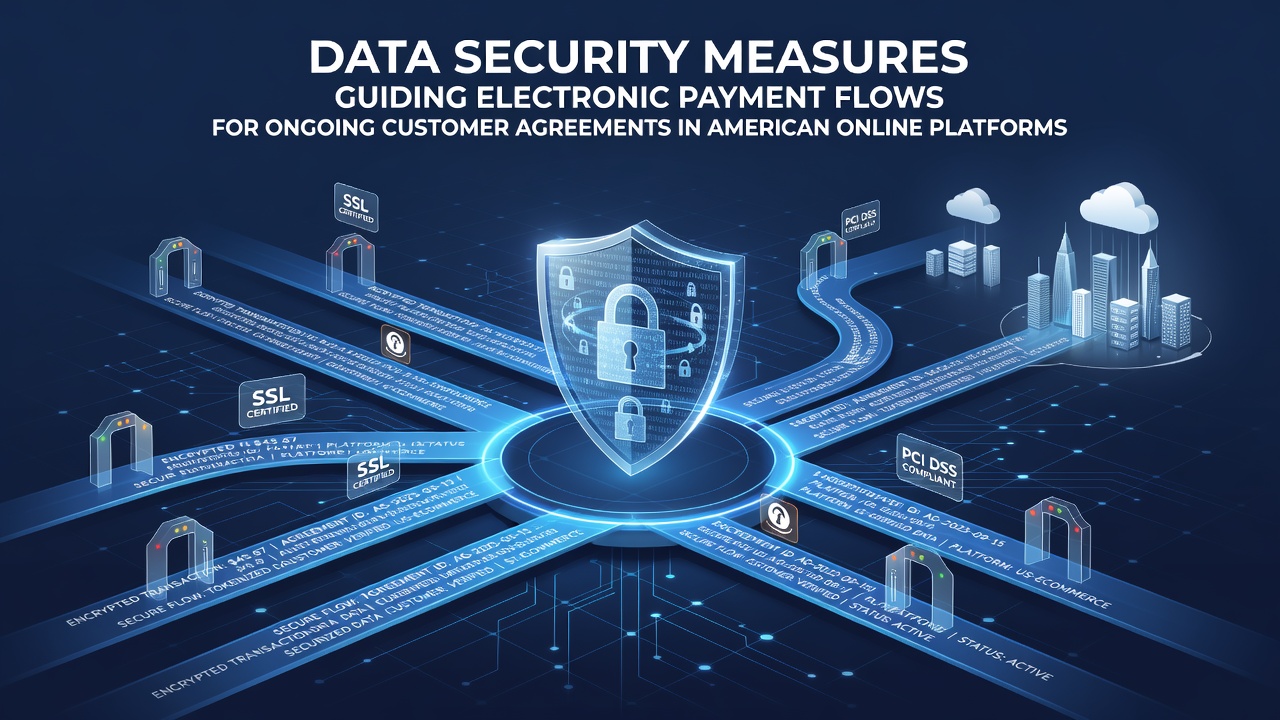
American online platforms handling recurring customer agreements rely on structured data security measures to manage electronic payment flows. These systems process subscriptions, memberships, and automated billing cycles where payment details move between customers, processors, and financial institutions on a repeated basis. Data protection in this environment centers on compliance requirements, technical controls, and operational procedures that address both credit card transactions and ACH transfers. Regulatory expectations shape much of the landscape. The Payment Card Industry Data Security Standard establishes baseline requirements for any entity storing, processing, or transmitting cardholder data, and American platforms integrate these rules into their recurring billing infrastructure. The Federal Trade Commission enforces additional safeguards under its authority over unfair or deceptive practices, requiring reasonable security measures for consumer financial information. As of June 2026, platforms continue to align operations with updates to these frameworks while monitoring state-level privacy statutes that affect how payment data can be retained across billing cycles. Encryption forms a core layer of protection. Platforms apply strong cryptographic protocols to card and bank account details both in transit and at rest, ensuring that data remains unreadable if intercepted during transmission between customer browsers, payment gateways, and backend databases. Tokenization replaces sensitive account numbers with unique identifiers that hold no intrinsic value, allowing recurring charges to proceed without repeated exposure of original payment credentials. Researchers at the National Institute of Standards and Technology have documented best practices for key management and algorithm selection that many US operators now reference when designing these systems.
NIST cybersecurity guidelines provide detailed recommendations on access controls that limit which personnel or automated processes can view or modify stored payment information. Role-based permissions, multi-factor authentication for administrative interfaces, and regular credential rotation reduce the risk of unauthorized access during the lifecycle of ongoing customer agreements. Platforms segment their networks so that systems handling payment flows operate separately from general web servers and marketing databases, containing potential breaches to narrower portions of the infrastructure. Monitoring tools track transaction patterns in real time. Anomaly detection systems flag unusual billing attempts, such as sudden changes in payment amounts or geographic locations inconsistent with customer history, triggering review before charges complete. Audit logs record every access event and data modification, creating traceable records that support both internal reviews and external examinations by regulators or acquiring banks. These logs prove essential when platforms must demonstrate compliance during periodic assessments required under PCI DSS. Data minimization principles guide retention policies. Many operators delete full card or bank details once tokenization occurs, storing only the tokens and minimal metadata needed for future billing cycles. This approach limits the volume of sensitive information available even if a security incident occurs. Platforms also implement secure deletion procedures for data that reaches the end of its required retention period, preventing indefinite accumulation of payment records tied to expired customer agreements.
FTC resources outline expectations for vendor management, requiring platforms to conduct due diligence on third-party processors and gateways that handle recurring flows. Contracts typically mandate equivalent security standards, breach notification timelines, and rights to audit. This contractual layer extends protection beyond a single organization's direct control, covering the full path payment data travels during automated deductions. Physical and environmental controls protect data centers and cloud environments where payment systems reside. Redundant power supplies, environmental monitoring, and restricted facility access complement digital safeguards. Cloud providers used by American platforms often undergo independent audits that verify alignment with recognized security benchmarks, giving operators documented assurance about the underlying infrastructure supporting their billing operations. Training programs ensure staff understand their responsibilities when working with payment data. Regular sessions cover recognition of phishing attempts, proper handling of customer inquiries involving billing details, and escalation procedures for suspected incidents. These human-focused measures address the reality that technical controls alone cannot prevent all risks in environments managing continuous payment streams.
Conclusion
American online platforms maintain layered data security approaches that integrate regulatory compliance, encryption, access management, monitoring, and vendor oversight to protect electronic payment flows tied to ongoing customer agreements. These measures evolve alongside standards updates and threat landscapes, supporting reliable recurring billing while addressing the specific requirements of credit and ACH transactions across digital marketplaces.